
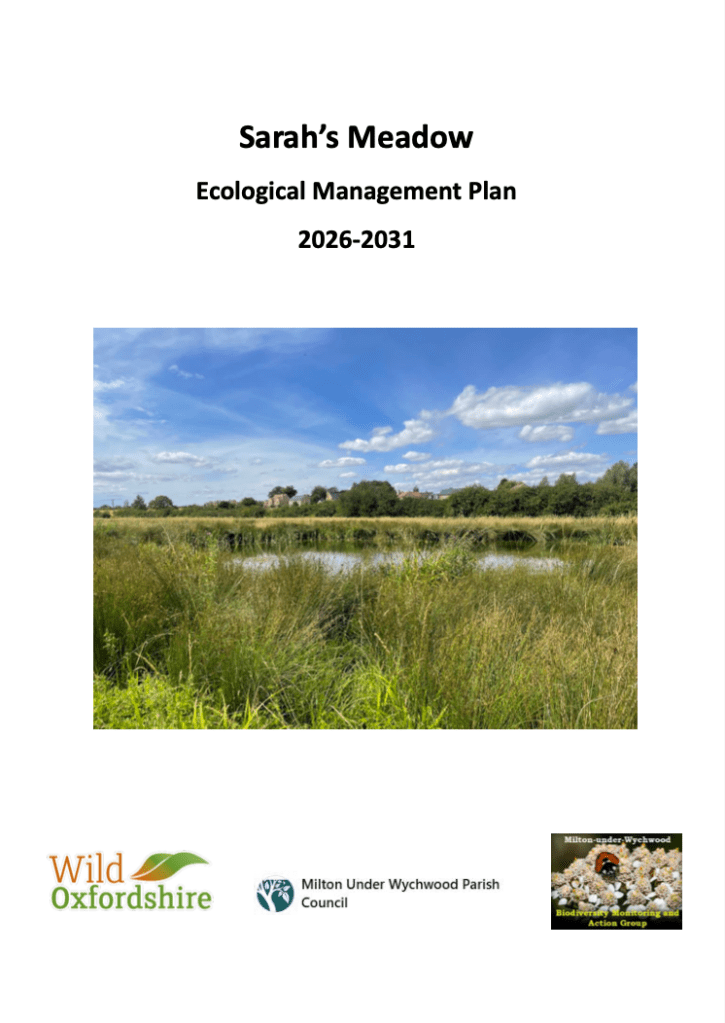
Ecological Management Plan 2026-2031
Sarah’s Meadow is situated within the Cotswolds National Landscape, previously referred to as the Cotswolds Area of Outstanding Natural Beauty (AONB). It holds no formal local or national conservation status and is designated as Local Green Space (LGS). The freshwater habitats, grassland and hedgerows within Sarah’s Meadows and neighbouring land are recognised as an important blue-green corridor within the local landscape (Milton under Wychwood Neighbourhood Plan, 2023). This management plan aims to build on Sarah Olney’s vision for the site to create a natural landscape, whilst providing a valuable green space for the community.
Sarah’s Meadow was previously a wet, uncultivated field used for rough grazing. It was transformed after the late Sarah Olney, of Natural England, proposed creating ponds within the site for natural flood management and to increase biodiversity. After funding was secured three ponds were created in 2023 in Sarah’s honour. These are fed by a spring which runs through an old stone culvert. Since then, the area has flourished and attracts a variety of terrestrial and aquatic wildlife. Originally known as the ‘Eco Area’ it is now fittingly named ‘Sarah’s Meadow’. Sarah was a champion for soil health, and this is acknowledged by the installation of ‘Sarah’s Seat’ in 2023 which is in the shape of a worm. The site acts as a peaceful refuge for both people and wildlife.
Management will focus on enhancing and maintaining grassland with scattered scrub and freshwater habitats, along with smaller habitat features and mosaics to attract a variety of species. A taskforce of volunteers will be built to enable a programme of work to be undertaken each year. Planned management tasks will be carried out by volunteers. No work task is expected to need contractors to complete it, however it is recognised that from time-to-time unforeseen events may result in specialist workforce and equipment being required, for example, tree works or maintenance to fencing.
You can read the full report and find out more about this important plan here
Heritage Summary
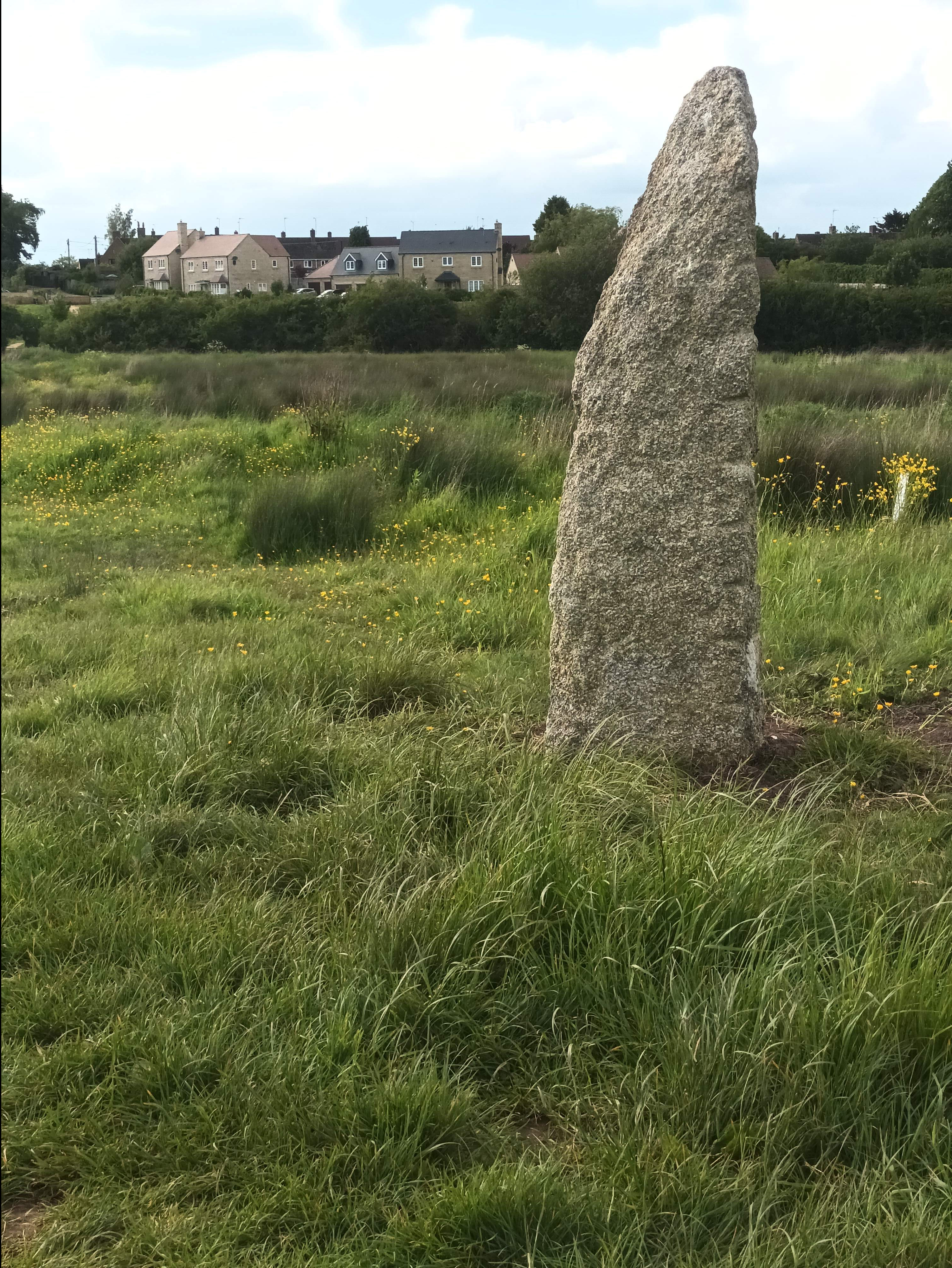
The field in which this stone stands was once known as “Callace Close”. A number of other fields and closes in this area had names like “Callace Corner” or “Callace Bank”.
The origin of the name “Callace” is not known. However, it does explain the mystery of the name “Calais Cottage”, a property situated nearby at the end of Frog Lane, unconnected with the French town of the same name!
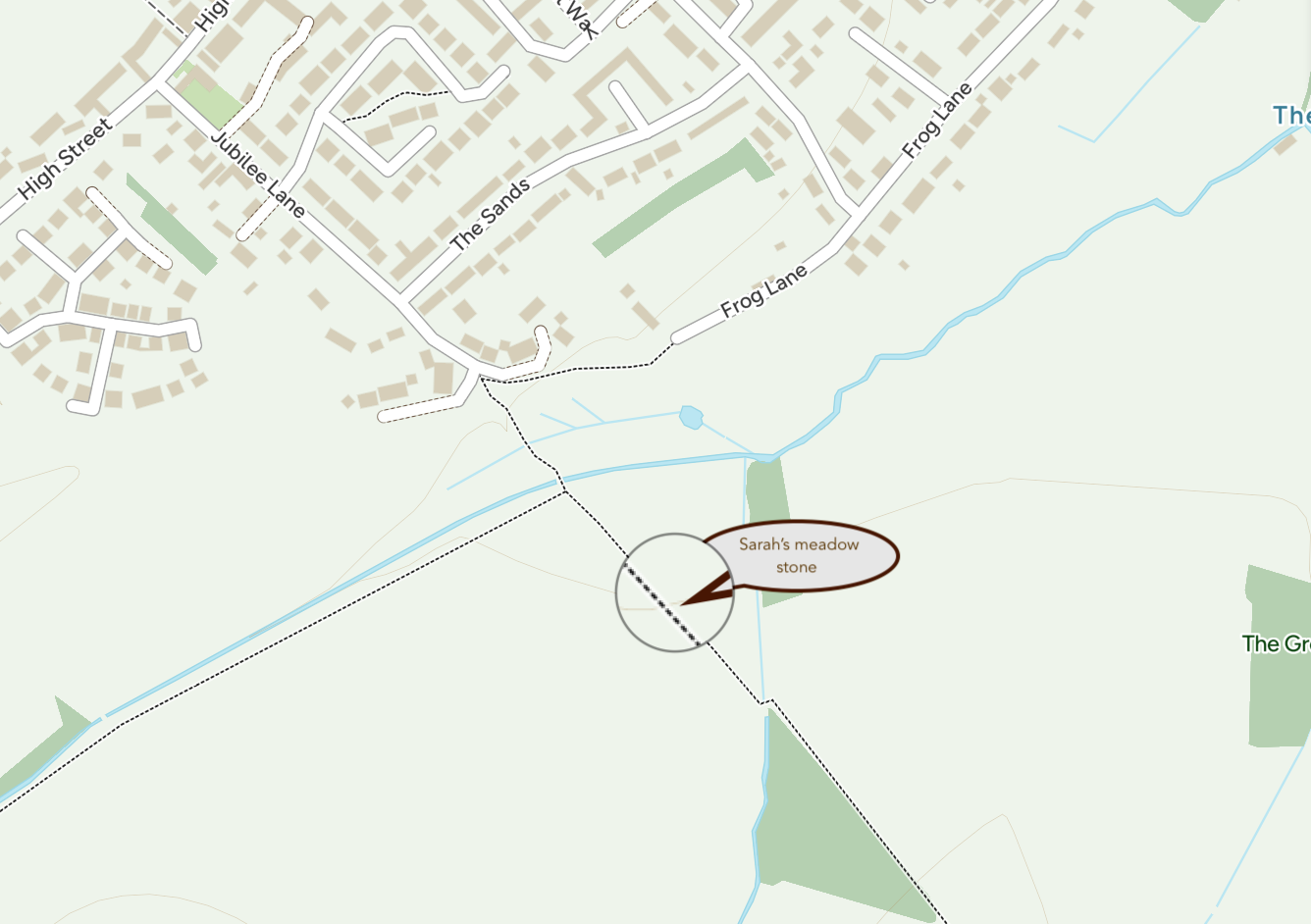
Very recently this triangle of land framed by the hedges, Simmonds Brook and the footpath leading to Dog Kennel Lane in Shipton, has been acquired by Milton Parish Council as part of the legacy of the building of St Jude’s Meadow; St Jude’s Stone > . It has been designated as a public green space for the village and is to be maintained as an area of ecological conservation and increased biodiversity.
Part of the process to increase biodiversity has been to excavate two ponds, which are fed by ancient culverted springs. The area has been re-named as Sarah’s Meadow in memory of local ecologist Sarah Olney who was instrumental in the creation of this field as a wildlife haven.
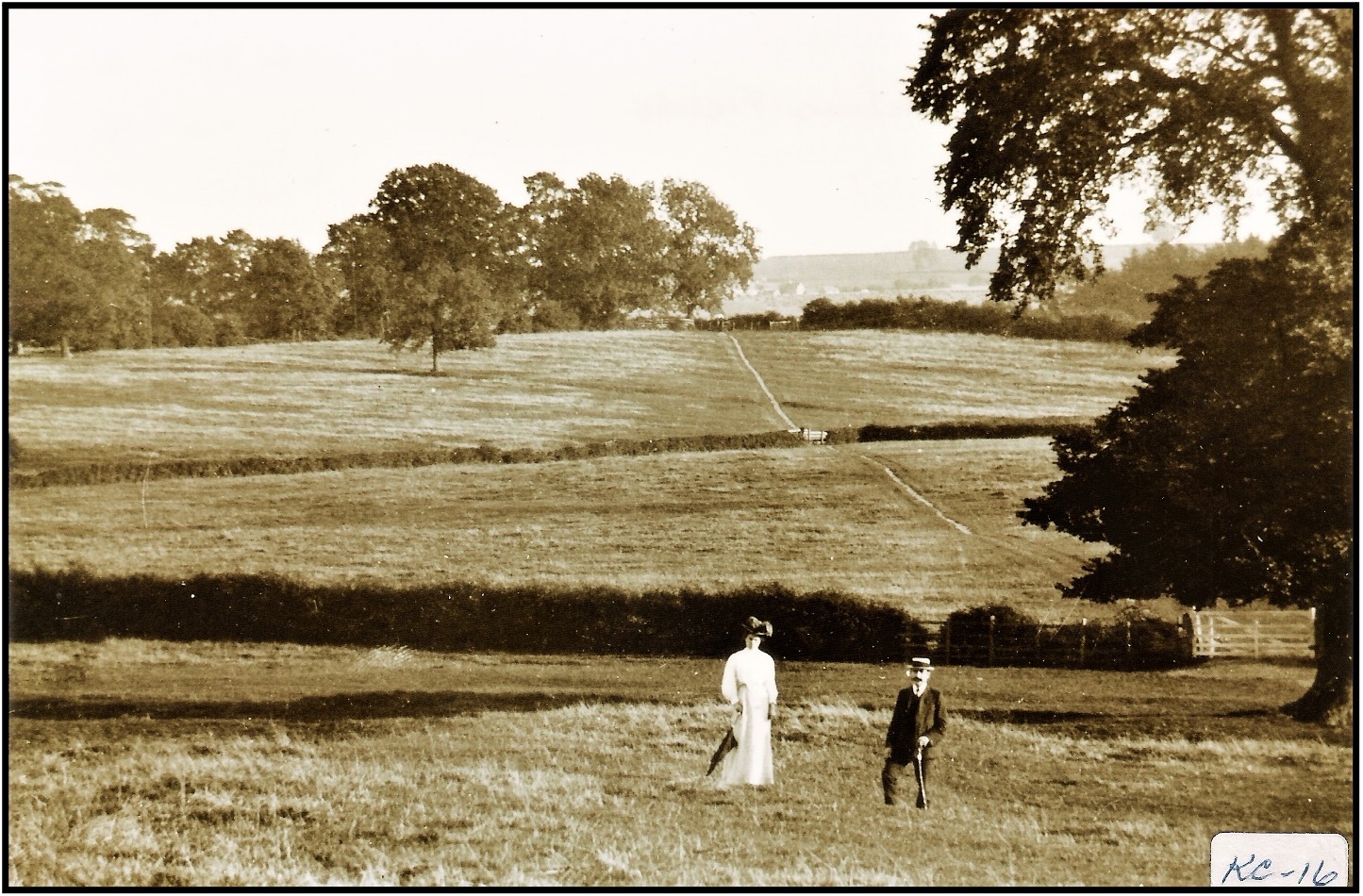
Milton village is situated on a rise of glacial sands and gravels, framed by Littlestock Brook and Simmonds Brook which skirt the eastern and western edges of the village.
The sand and gravel were useful resources and were exploited by local builders, in particular the Groves family of masons and builders. The sand and gravel were particularly accessible on this western edge close to Simmonds Brook.
The area to the north of the stream has long been known as The Sands, even before the building of a street of one-time council houses that now takes this name.
Gardeners living in The Sands are only too familiar with the layers of sand, gravel and clay beneath their gardens. The local clay has been used to line the two new ponds. Sand, gravel and potatoes >
Chipping Norton Rural District Council compulsorily purchased part of The Sands just after the Second World War, and a street of houses was built in the early 1950s as part of the post-war Council House building boom; The Sands >
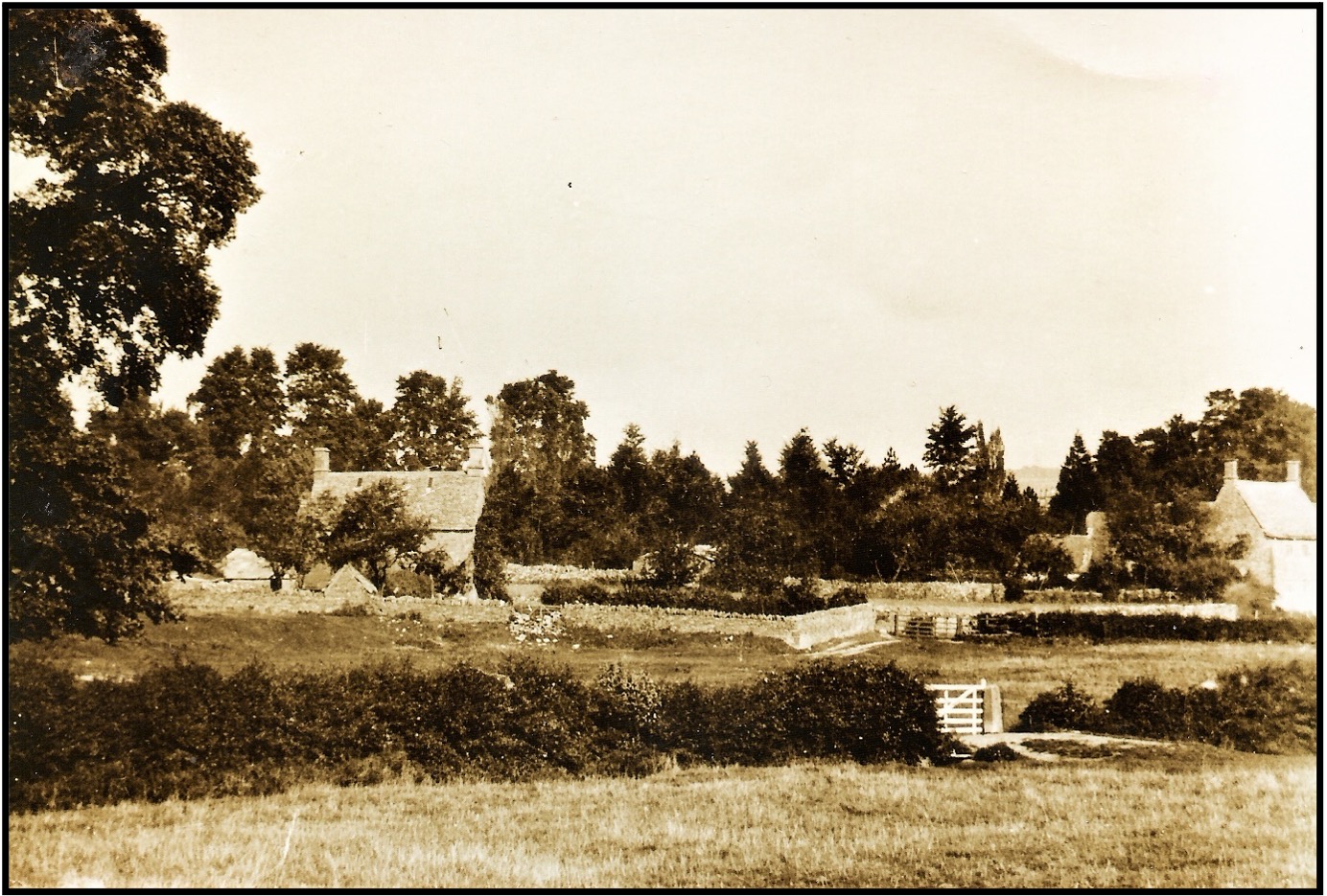
Some ponds have been dug in this area, one very close to this stone.
An old stone-lined drain feeds into one of these ponds which then drains into Simmonds Brook. This drain is believed to date from the 17th Century, or at least from a period before clay drainage pipes came into common use (mid to late 18th century). It is one of a number of such drains that were built to feed into Simmonds Brook.
These drains were constructed to improve the water supply to the brook so that it could provide a more reliable and robust supply to the water mill downstream. There were once several feeder drains built for this purpose, but most of these have now been silted up or otherwise disturbed. This one remains an interesting historical survivor.
Sand, gravel and potatoes
The area to the north of Simmonds Brook was long known as The Sands, and was a source of sand and gravel excavated by local builders.
Local memory records inventive uses of these old sand and gravel pits. In the 19th Century they served as useful dumping grounds for “night soil” — the waste from earth closets before mains sewage systems arrived — and it is known that Groves builders also used these pits to dispose of sawdust from their extensive timber works, which flourished in Milton in the first half of the 20th Century.
In consequence of this rich mix of sand, sawdust and manure the area was said to be excellent for growing potatoes!

The Sands
The Sands is a street on the south-eastern edge of Milton consisting of just over 60 individual properties.
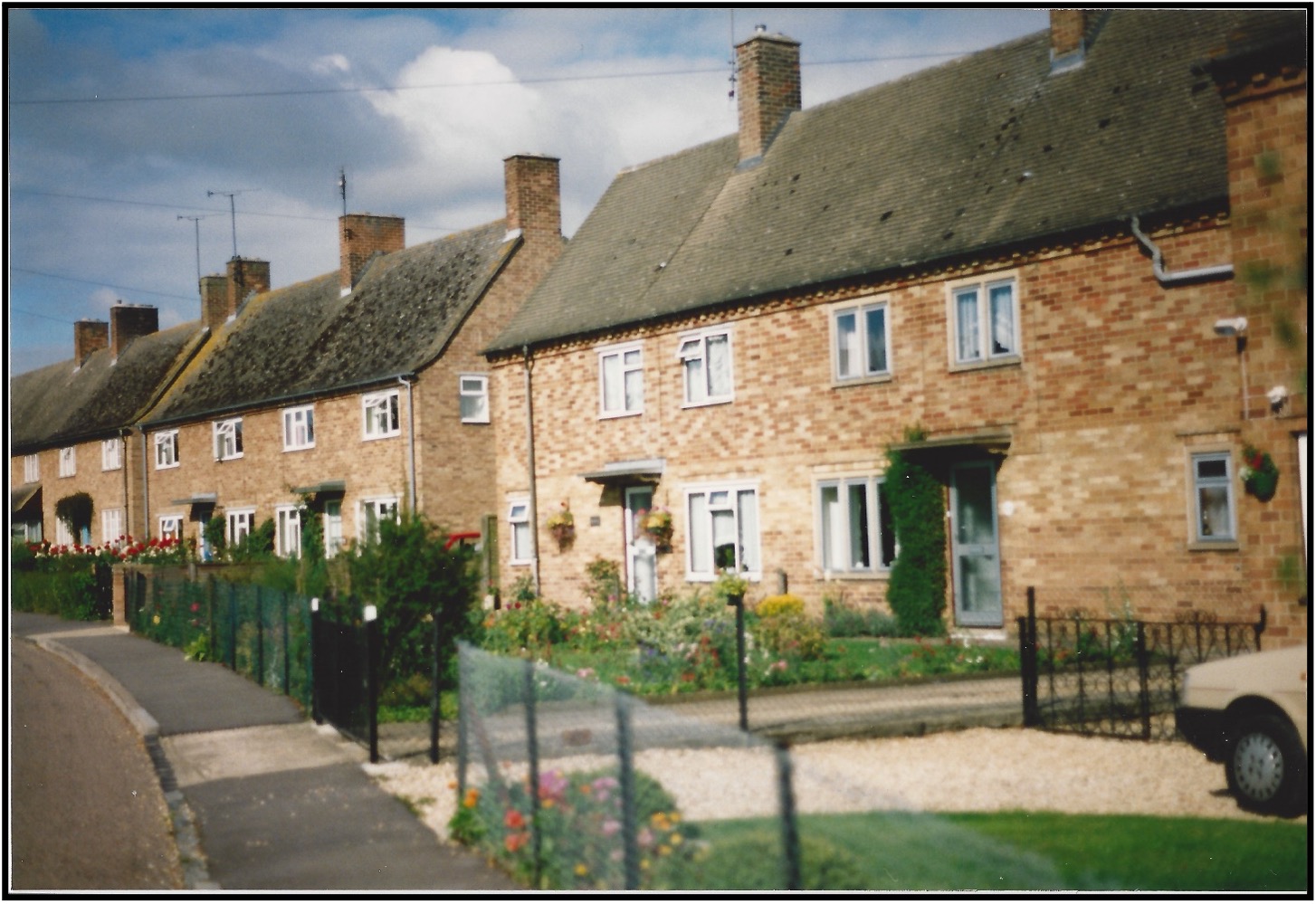
The land was acquired under a compulsory purchase order by Chipping Norton Rural District Council shortly after the Second World War. The houses were built in phases in the early 1950s, part of the post-war housing boom. They occupy a wide street with generous gardens to the front and back. A range of accommodation has been created with a mix of semi-detached properties and a square of bungalows. There are chimney stacks and steeply pitched roofs, and while these houses introduce the first large scale use of brick in the village, they are of a buff colour that matches well with the local Cotswold stone. The designer was Oxford architect Thomas Rayson (1888-1976).
Quotes
Auguries of Innocence
By William Blake, a 19th century poet and artist. The opening lines of the poem quoted on the slate suggest looking closely at the natural world around us, something that Sarah’s Meadow (where the slate is sited) gives us all an opportunity to do.
To see a World in a Grain of Sand
And a Heaven in a Wild Flower
Hold Infinity in the palm of your hand
And Eternity in an hour
A Robin Red breast in a Cage
Puts all Heaven in a Rage
A Dove house filld with Doves & Pigeons
Shudders Hell thr’ all its regions
A dog starvd at his Masters Gate
Predicts the ruin of the State
A Horse misusd upon the Road
Calls to Heaven for Human blood
Each outcry of the hunted Hare
A fibre from the Brain does tear
A Skylark wounded in the wing
A Cherubim does cease to sing
The Game Cock clipd & armd for fight
Does the Rising Sun affright
Every Wolfs & Lions howl
Raises from Hell a Human Soul
The wild deer, wandring here & there
Keeps the Human Soul from Care
The Lamb misusd breeds Public Strife
And yet forgives the Butchers knife
The Bat that flits at close of Eve
Has left the Brain that wont Believe
The Owl that calls upon the Night
Speaks the Unbelievers fright
He who shall hurt the little Wren
Shall never be belovd by Men
He who the Ox to wrath has movd
Shall never be by Woman lovd
The wanton Boy that kills the Fly
Shall feel the Spiders enmity
He who torments the Chafers Sprite
Weaves a Bower in endless Night
The Catterpiller on the Leaf
Repeats to thee thy Mothers grief
Kill not the Moth nor Butterfly
For the Last Judgment draweth nigh
He who shall train the Horse to War
Shall never pass the Polar Bar
The Beggars Dog & Widows Cat
Feed them & thou wilt grow fat
The Gnat that sings his Summers Song
Poison gets from Slanders tongue
The poison of the Snake & Newt
Is the sweat of Envys Foot
The poison of the Honey Bee
Is the Artists Jealousy
The Princes Robes & Beggars Rags
Are Toadstools on the Misers Bags
A Truth thats told with bad intent
Beats all the Lies you can invent
It is right it should be so
Man was made for Joy & Woe
And when this we rightly know
Thro the World we safely go
Joy & Woe are woven fine
A Clothing for the soul divine
Under every grief & pine
Runs a joy with silken twine
The Babe is more than swadling Bands
Throughout all these Human Lands
Tools were made & Born were hands
Every Farmer Understands
Every Tear from Every Eye
Becomes a Babe in Eternity
This is caught by Females bright
And returnd to its own delight
The Bleat the Bark Bellow & Roar
Are Waves that Beat on Heavens Shore
The Babe that weeps the Rod beneath
Writes Revenge in realms of Death
The Beggars Rags fluttering in Air
Does to Rags the Heavens tear
The Soldier armd with Sword & Gun
Palsied strikes the Summers Sun
The poor Mans Farthing is worth more
Than all the Gold on Africs Shore
One Mite wrung from the Labrers hands
Shall buy & sell the Misers Lands
Or if protected from on high
Does that whole Nation sell & buy
He who mocks the Infants Faith
Shall be mockd in Age & Death
He who shall teach the Child to Doubt
The rotting Grave shall neer get out
He who respects the Infants faith
Triumphs over Hell & Death
The Childs Toys & the Old Mans Reasons
Are the Fruits of the Two seasons
The Questioner who sits so sly
Shall never know how to Reply
He who replies to words of Doubt
Doth put the Light of Knowledge out
The Strongest Poison ever known
Came from Caesars Laurel Crown
Nought can Deform the Human Race
Like to the Armours iron brace
When Gold & Gems adorn the Plow
To peaceful Arts shall Envy Bow
A Riddle or the Crickets Cry
Is to Doubt a fit Reply
The Emmets Inch & Eagles Mile
Make Lame Philosophy to smile
He who Doubts from what he sees
Will neer Believe do what you Please
If the Sun & Moon should Doubt
Theyd immediately Go out
To be in a Passion you Good may Do
But no Good if a Passion is in you
The Whore & Gambler by the State
Licencd build that Nations Fate
The Harlots cry from Street to Street
Shall weave Old Englands winding Sheet
The Winners Shout the Losers Curse
Dance before dead Englands Hearse
Every Night & every Morn
Some to Misery are Born
Every Morn and every Night
Some are Born to sweet delight
Some are Born to Endless Night
We are led to Believe a Lie
When we see not Thro the Eye
Which was Born in a Night to perish in a Night
When the Soul Slept in Beams of Light
God Appears & God is Light
To those poor Souls who dwell in Night
But does a Human Form Display
To those who Dwell in Realms of day
 Milton-under-Wychwood