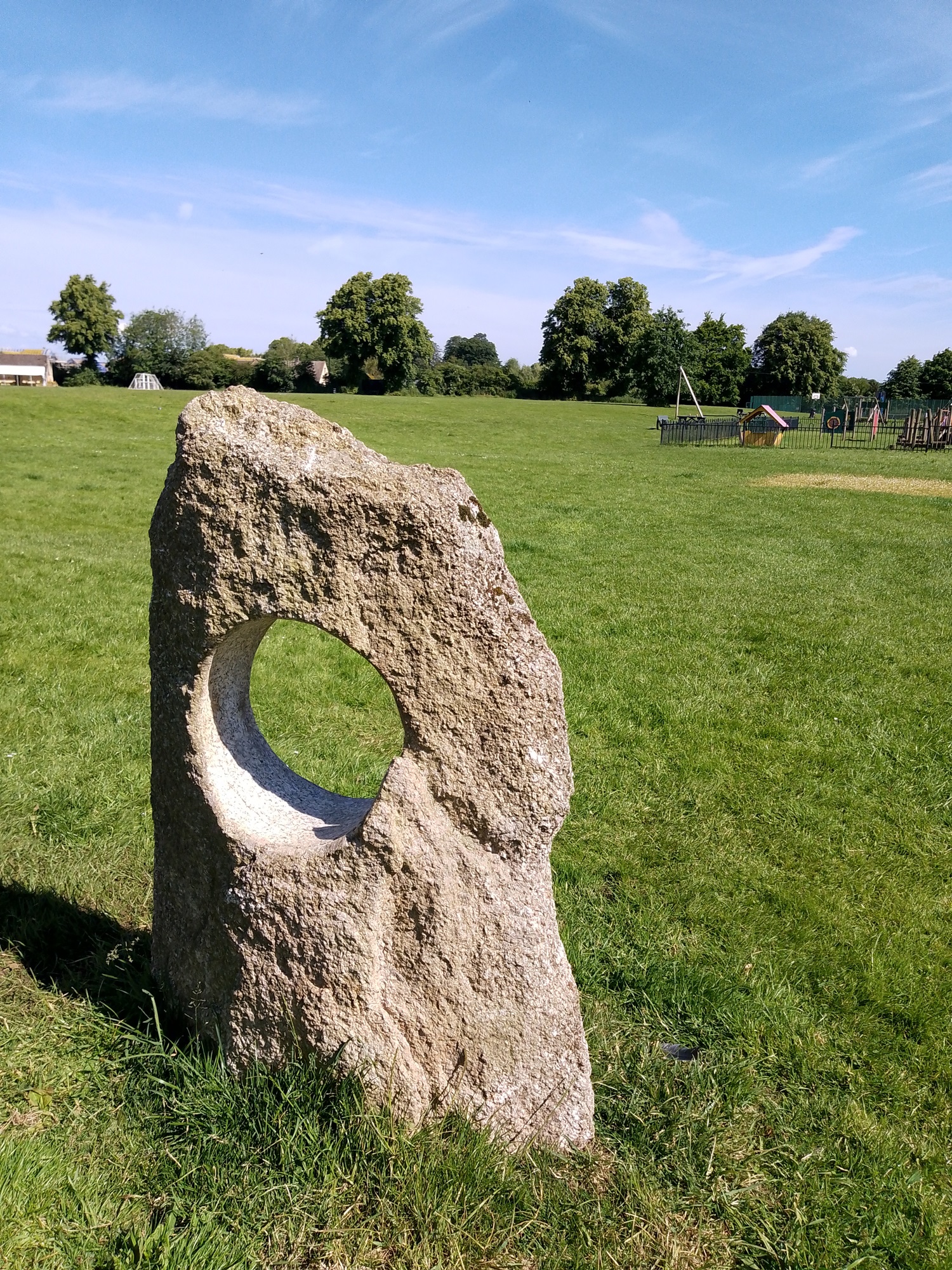

Heritage Summary
The Village Green, also known as the Recreation Ground, has long been a hub for recreation and relaxation at the heart of the village. Events & Activities >
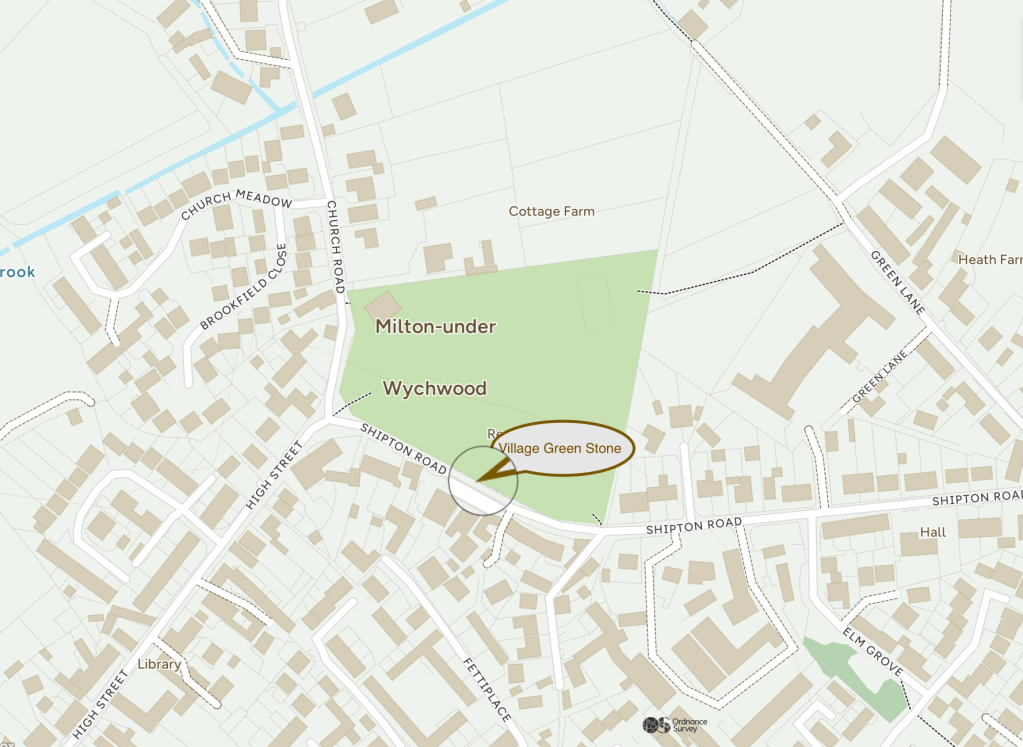
Key historic streets converge at the northern corner of the Green, near the village pub and the former post office and stores.
Originally common pasture, the Green was designated as the Recreation Ground in 1849, at the time of Enclosure > It was once more extensive than it is now, being bounded by Church Road, Shipton Road and Green Lane. However, the area between this stone and the junction of Green Lane and Shipton Road was built over in the 1920s and 1930s with the arrival of the first council housing in the village.
Following Enclosure, the Green had a dual function as pasture and for recreation. Sometimes conflicts arose between these two activities Sports >
Today the Green is managed by Milton-under-Wychwood Parish Council on behalf of the residents.
Events and Activities
Throughout its history, the Green has hosted significant events.
In the 19th Century, it was a venue for lively ‘Camp Meetings’ organised by the Primitive Methodists, drawing large crowds.
In the 1870s it was the location for gatherings of the Agricultural Labourers’ Union, led by the charismatic Joseph Arch. In the same period emigration agents held meetings on the Green, enticing locals to move to New Zealand, Australia, and Canada. Meetings >
Cricket was once a popular sport on the Green, but gradually football has taken its place. Sports > Nowadays, the Green hosts sporting fixtures, village fetes, coronation and jubilee celebrations, fun fairs, and occasional markets. Recreation & Celebration >
During the Second World War troops were billeted in various locations around the village, including an encampment on the Green; and trenches were dug, probably as part of rehearsals for real-life manoeuvres. Locals recall that it was quite some time before they were filled in again.
Meetings
The Green has been an arena for significant public events in village life. In the second half of the 19th Century, it was a location for large “Camp Meetings” organized by the Primitive Methodists. The Primitive Methodists, alongside other nonconformist groups, had established a presence in west Oxfordshire from the 1830s, and had built a chapel in a prime location in Milton in 1860. This chapel still stands on the opposite side of the road from this stone, though it is now a private house. The camp meetings were lively gatherings of energetic preaching and praying that drew large crowds of adherents and the curious. The Village Green must have provided an ideal location for these gatherings just on the doorstep of their Milton chapel. Primitive Methodists in the Wychwoods >
In the 1870s there were equally large gatherings of the nascent Agricultural Labourers’ Union, often presided over by Joseph Arch (1826-1914), the charismatic leader of the union. Arch, a former hedger and ditcher from Barford in Warwickshire, was a Primitive Methodist lay preacher, besides becoming leader of the Union, and later in life a Liberal MP. He visited Milton on a number of occasions to promote the Union. He was present at an early mass meeting of agricultural labourers in Milton, which took place on the “public green” in July 1872. Newspaper reports of Arch’s speech reveal a religious fervour for the union cause: “The labourer . . . was as respectable as the farmer, because God made him, and to trample upon the labourer was to trample upon God’s property. The working man ought to be as much respected as any man, and he wanted a fair share in the produce of the country.” (Jackson’s Oxford Journal, 6th July 1872). The presence of a Primitive Methodist chapel in Milton undoubtedly assisted the Union’s cause in the village.
The NALU also promoted emigration as a way of reducing a labour surplus. There are records of large emigration meetings held in a marquee on the Green. These were hosted by emigration agents who attempted to entice local families to a life in New Zealand, Australia and Canada, many went from the Wychwoods area in the 1870s leading to a notable decrease in the local population. Wychwood Local History Society article > ; Wychwood Local History society recording >
Enclosure
Prior to Enclosure the Village Green was once an important area of common pasture in Milton, though this was carefully regulated by the local Vestry meetings (a forerunner of the Parish Council).
Following Milton’s Enclosure in 1849 the area was designated as the Recreation Ground. However, the rights of pasture continued to be rented out to local farmers until the 1950s.
Nowadays, the Green is used exclusively for recreational purposes under the auspices of a Parish Council Trust.

Sports
The Village Green has long been a venue for sports of all kinds.
Cricket was played on the Green from at least the 1860s, and there are many contemporary press reports of cricket matches in Milton. However, at this time village pitches were often little more than rough grazing fields in which the wicket might be fenced round to keep livestock off. In 1870 the Parish Council added a sixth rule to those already in existence for the operation of the Recreation Ground: ’The Public not to be interrupted in their Recreations such as cricket playing etc.’
Cricketers playing on Milton Green would often have found themselves having to remove livestock and cowpats from the outfield before the game could begin! Scores were low as the ball did not travel far or very fast on the uneven ground, realistically the only way to score runs was by hitting the ball over the boundary!
Milton fielded a village team in the later 19th Century. In July 1881 the Chipping Norton Deanery Magazine included a report on two matches played that month by the Milton Cricket Club against Charlbury and Chipping Norton. The results being lost one, won one.
Surviving photographs suggest that the team flourished in the first half of the 20th Century. In particular, the 1949-50 XI won the Witney League Cup, defeating Witney Swifts in the final match of the season. The village retained its cricket team until the 1990s. Cricket continues to be played in the Wychwoods with teams in nearby Ascott and Shipton. Wychwoods History article >


Recreation and Celebration
The Village Green should be more correctly known as the Recreation Ground and was conceived as such when Milton was Enclosed in 1849, this area being designated as an area for public recreation. This was a common condition added to Enclosure awards in the 19th Century.
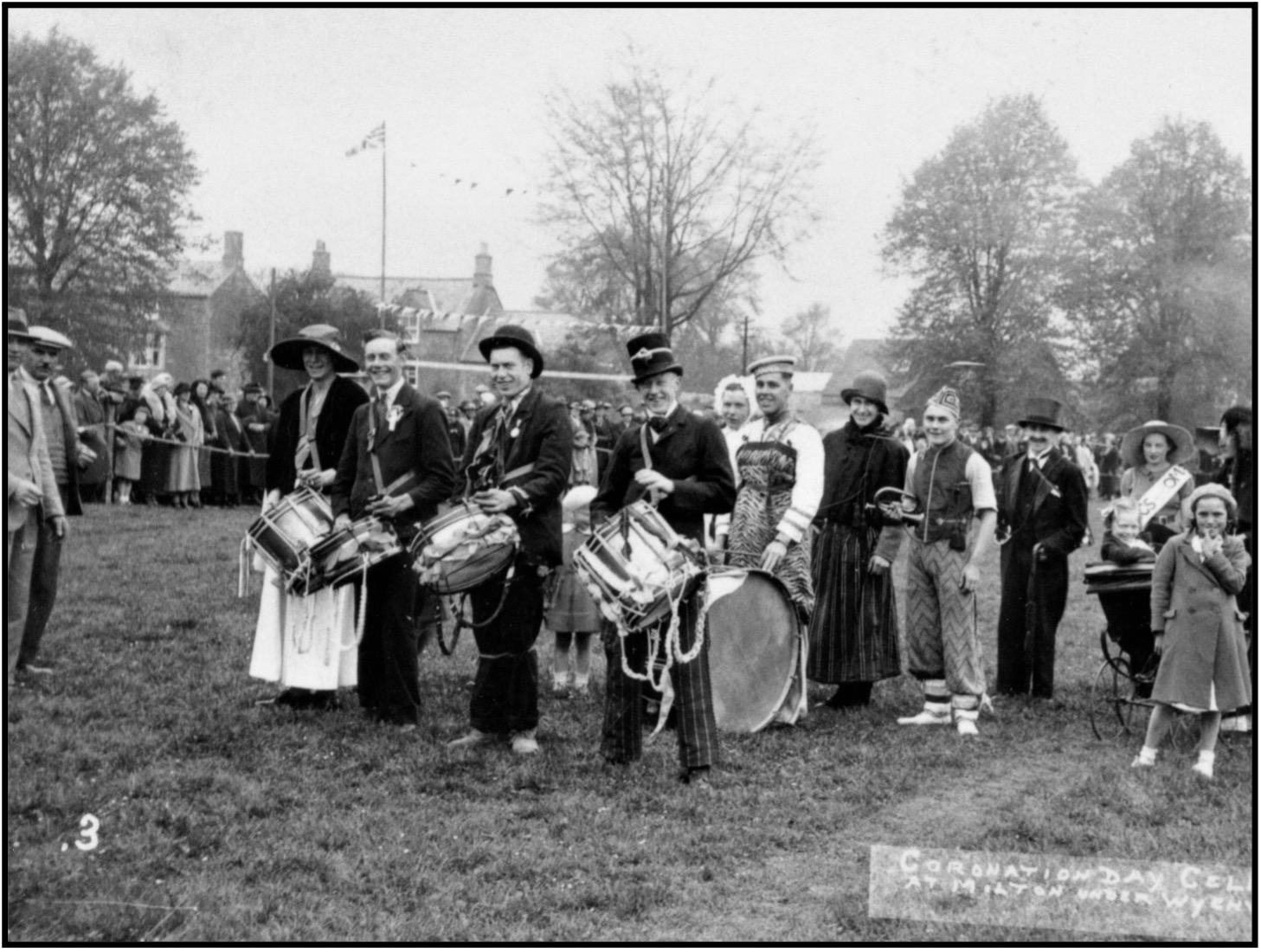
Besides the large public meetings and sports, it was, and still is, a useful arena for many public celebrations. For example, at Milton fete, the parade of floats around the village has always terminated on the Green. It has also been the principle venue for many coronation and royal jubilee celebrations. Wychwoods History Royal visits & jubilee celebrations >
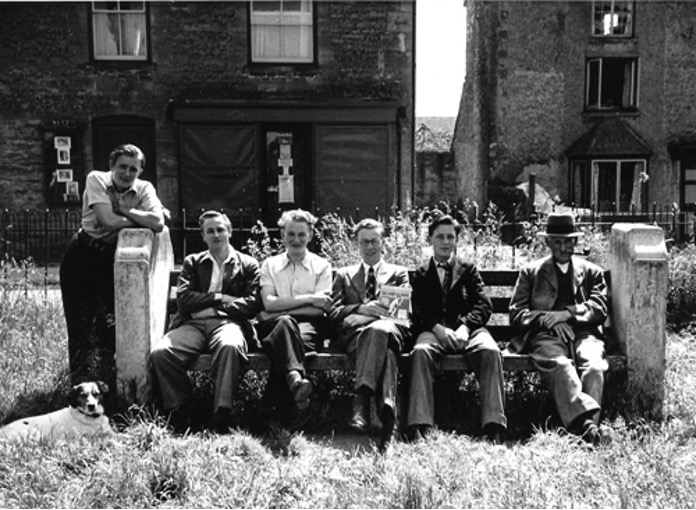
In 1935 new benches were installed to commemorate the Silver Jubilee of the reign of George V, and in 1977 new gates were added to the Green to commemorate Elizabeth II’s Silver Jubilee.
In more recent years play equipment has been erected on the Green, a paddling pool came and went, and a fenced children’s play area was installed in the early 2000s. A tennis court was added in the 1970s. The Green has also hosted funfairs and occasional markets.
Quotes
Jude the Obscure
By Thomas Hardy. The quote is taken from Hardy’s 19th century novel about Jude Fawley, a stonemason. It is referenced here because of Milton-under-Wychwood’s strong historical links with stonemasonry. The notes on Milton’s history give a rich illustration of that stonemasonry heritage.
 Milton-under-Wychwood
test